

Role playing has always been one of the most effective ways to learn, practice, and prepare for real-life situations.
Whether it is actors rehearsing for a play, employees training for customer interactions, or students building communication skills, role play helps people test ideas in a safe space before applying them in the real world.
Until recently, role playing depended on other people. You needed a teacher, a coach, or a group of peers to make it work. That limited how often you could practice and how flexible the scenarios could be.
Now things are changing. AI agents for role playing give people the ability to simulate conversations, challenges, and interactions on demand.
In this article, we will explore how AI agents make role playing more accessible and effective, why they are valuable across industries, and how to use them in practice.
Why AI Role Playing Matters
Role playing is not just an exercise. It is a way of stepping into situations that are difficult, unfamiliar, or high-stakes and practicing your response before it really counts.
A salesperson can rehearse handling objections. A doctor can practice delivering difficult news. A student can role play a job interview.
The benefit comes from experience without risk. By acting out scenarios, you build confidence, spot weaknesses, and refine your approach. You are not just memorizing responses, you are training yourself to adapt in the moment.
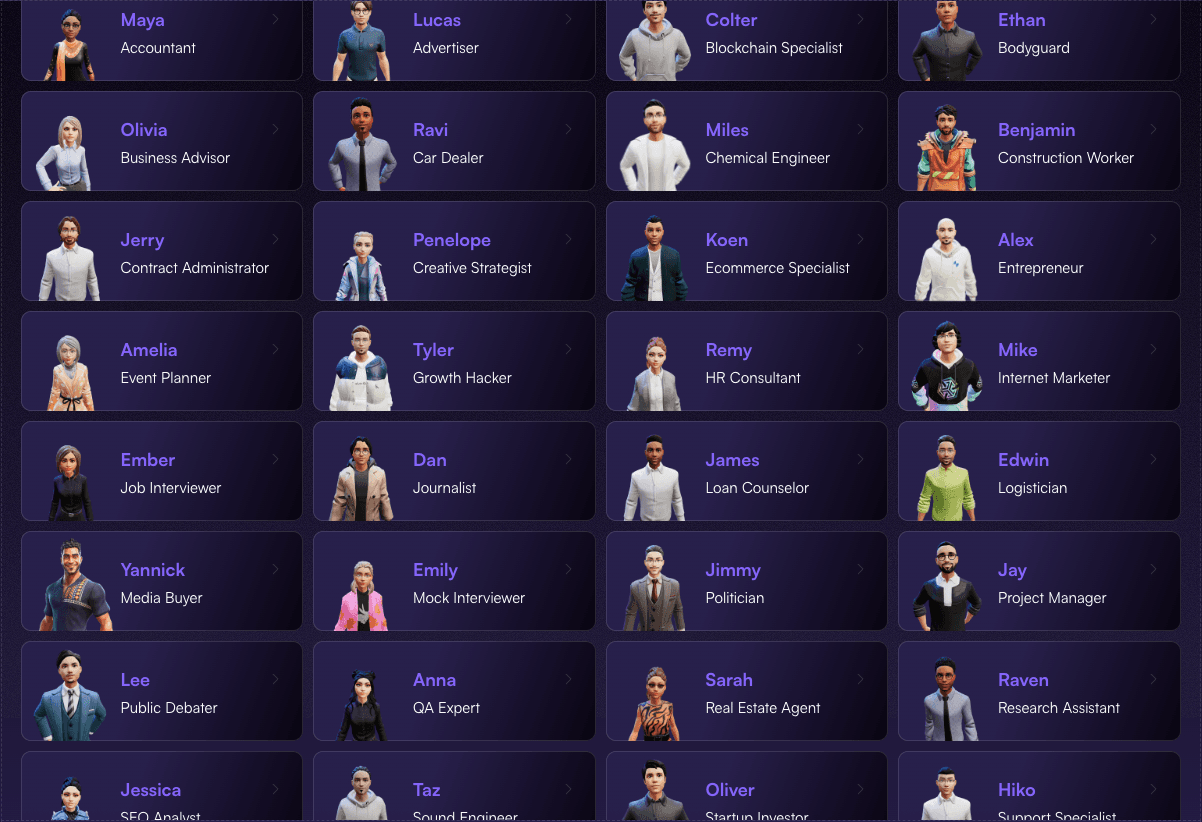
The best part? Agent.so has hundreds of AI Agents that can role play scenarios based on their expertise like Emily, the AI mock interviewer.
What AI Adds to Role Playing
AI agents transform role playing by removing traditional barriers. You no longer need to find a partner or schedule a session.
An AI agent is available anytime, ready to take on any role you need. It can be a supportive customer, a skeptical client, a curious student, or even a historical figure.
Because AI agents can generate endless dialogue, they keep scenarios fresh. Instead of repeating the same script, you get dynamic conversations that push you to think and react in real time.
They also provide feedback, pointing out stronger ways to phrase something or offering suggestions for improvement.
Different Ways AI Role Play Can Be Used
AI role playing is not limited to one area. It has practical applications across personal growth, education, and professional development.
Practicing Communication Skills
Public speaking, interviewing, or debating can feel intimidating. AI agents let you rehearse these interactions privately until you feel confident. You can practice answering tough questions, holding conversations in another language, or adjusting your tone for different audiences.
Training for Customer Scenarios
Businesses are using AI to simulate customer service situations. Employees can practice handling complaints, solving technical problems, or upselling products. Each scenario can be adjusted for difficulty, giving staff a chance to build resilience before facing real customers.
Preparing for High-Stakes Roles
Doctors, lawyers, and emergency responders benefit from simulations. AI agents can take on the role of patients, clients, or distressed individuals, allowing professionals to practice communication under pressure.
Exploring Creative Storytelling
Role playing is not always about training. Writers, game designers, and hobbyists use AI agents to explore characters, invent dialogue, and create storylines. AI can role play as a character in a fantasy world, a historical figure, or a completely fictional creation, opening new doors for creativity.
How to Use AI Agents for Role Play
Dive into real-life scenarios with AI agents to sharpen skills, from high-stakes moments to everyday chats. Role-playing via text or voice builds confidence and muscle memory.
Here's how you can do it:
Craft a Killer Prompt: give clear roles and scenes: "Be a tough hiring manager for a sales job. Quiz my experience and throw curveballs."
Layer in Details for Depth: add specifics like emotions or disruptions: "Simulate a heated negotiation with an upset client."
Escalate Challenges Gradually: start basic, then amp up: "Switch to tough questions, like handling failure."
Seek Instant Feedback and Iterate: ask post-session: "Critique my responses for clarity." Refine and replay variations for mastery.
Blend Chat and Voice for Hybrid Wins: use chat for quick drills, voice for realism. Alternate for full prep, like meetings or calls.

Tips for Getting the Most Out of AI Role Play
To maximize the value of AI role playing, keep a few principles in mind:
Be specific with scenarios: Instead of saying “Role play with me,” try “Act as a customer upset about a late delivery.” The more detail you give, the more realistic the practice will be.
Ask for feedback: After the role play, ask the AI to evaluate your responses. This helps you learn what to improve.
Practice regularly: Short, frequent sessions are more effective than occasional long ones.
Use it alongside real experiences: AI prepares you, but pairing it with real conversations makes learning complete.
Addressing Concerns
Some people worry that AI role play is too artificial. While it is not the same as practicing with humans, it serves as a valuable bridge.
It provides a safe space where mistakes are part of learning. By the time you face the real scenario, you are better prepared.
Others ask whether AI can really capture human nuance. While it may not be perfect, AI is improving rapidly. Today’s agents can already simulate a wide range of emotions, tones, and behaviors, making practice surprisingly realistic.
The Future of Role Playing With AI
As AI continues to advance, role playing will only become more immersive. Soon, you may step into virtual environments where AI characters interact with you in realistic settings, from a busy restaurant to a courtroom.
Combined with voice and gesture recognition, this could feel like true rehearsal for real life.
The future is not just about making role play more realistic, but also more personal. AI may soon track your progress over time, tailoring scenarios to your growth and offering increasingly complex challenges as your skills improve.

Practicing for Real Life With AI Agents
Role playing has always been one of the most effective ways to build confidence and prepare for important moments. With AI agents, it becomes more flexible, more available, and more engaging. You can practice anytime, in any scenario, and receive feedback that helps you grow.
Whether you are preparing for an interview, training for your career, or simply exploring creative storytelling, AI agents give you a partner who never gets tired and is always ready to help.
The best way to get better at anything is to practice. With AI role playing, practice is no longer limited by time, place, or people. It is always in your pocket, ready to prepare you for whatever comes next.
Role playing has always been one of the most effective ways to learn, practice, and prepare for real-life situations.
Whether it is actors rehearsing for a play, employees training for customer interactions, or students building communication skills, role play helps people test ideas in a safe space before applying them in the real world.
Until recently, role playing depended on other people. You needed a teacher, a coach, or a group of peers to make it work. That limited how often you could practice and how flexible the scenarios could be.
Now things are changing. AI agents for role playing give people the ability to simulate conversations, challenges, and interactions on demand.
In this article, we will explore how AI agents make role playing more accessible and effective, why they are valuable across industries, and how to use them in practice.
Why AI Role Playing Matters
Role playing is not just an exercise. It is a way of stepping into situations that are difficult, unfamiliar, or high-stakes and practicing your response before it really counts.
A salesperson can rehearse handling objections. A doctor can practice delivering difficult news. A student can role play a job interview.
The benefit comes from experience without risk. By acting out scenarios, you build confidence, spot weaknesses, and refine your approach. You are not just memorizing responses, you are training yourself to adapt in the moment.
The best part? Agent.so has hundreds of AI Agents that can role play scenarios based on their expertise like Emily, the AI mock interviewer.
What AI Adds to Role Playing
AI agents transform role playing by removing traditional barriers. You no longer need to find a partner or schedule a session.
An AI agent is available anytime, ready to take on any role you need. It can be a supportive customer, a skeptical client, a curious student, or even a historical figure.
Because AI agents can generate endless dialogue, they keep scenarios fresh. Instead of repeating the same script, you get dynamic conversations that push you to think and react in real time.
They also provide feedback, pointing out stronger ways to phrase something or offering suggestions for improvement.
Different Ways AI Role Play Can Be Used
AI role playing is not limited to one area. It has practical applications across personal growth, education, and professional development.
Practicing Communication Skills
Public speaking, interviewing, or debating can feel intimidating. AI agents let you rehearse these interactions privately until you feel confident. You can practice answering tough questions, holding conversations in another language, or adjusting your tone for different audiences.
Training for Customer Scenarios
Businesses are using AI to simulate customer service situations. Employees can practice handling complaints, solving technical problems, or upselling products. Each scenario can be adjusted for difficulty, giving staff a chance to build resilience before facing real customers.
Preparing for High-Stakes Roles
Doctors, lawyers, and emergency responders benefit from simulations. AI agents can take on the role of patients, clients, or distressed individuals, allowing professionals to practice communication under pressure.
Exploring Creative Storytelling
Role playing is not always about training. Writers, game designers, and hobbyists use AI agents to explore characters, invent dialogue, and create storylines. AI can role play as a character in a fantasy world, a historical figure, or a completely fictional creation, opening new doors for creativity.
How to Use AI Agents for Role Play
Dive into real-life scenarios with AI agents to sharpen skills, from high-stakes moments to everyday chats. Role-playing via text or voice builds confidence and muscle memory.
Here's how you can do it:
Craft a Killer Prompt: give clear roles and scenes: "Be a tough hiring manager for a sales job. Quiz my experience and throw curveballs."
Layer in Details for Depth: add specifics like emotions or disruptions: "Simulate a heated negotiation with an upset client."
Escalate Challenges Gradually: start basic, then amp up: "Switch to tough questions, like handling failure."
Seek Instant Feedback and Iterate: ask post-session: "Critique my responses for clarity." Refine and replay variations for mastery.
Blend Chat and Voice for Hybrid Wins: use chat for quick drills, voice for realism. Alternate for full prep, like meetings or calls.
Tips for Getting the Most Out of AI Role Play
To maximize the value of AI role playing, keep a few principles in mind:
Be specific with scenarios: Instead of saying “Role play with me,” try “Act as a customer upset about a late delivery.” The more detail you give, the more realistic the practice will be.
Ask for feedback: After the role play, ask the AI to evaluate your responses. This helps you learn what to improve.
Practice regularly: Short, frequent sessions are more effective than occasional long ones.
Use it alongside real experiences: AI prepares you, but pairing it with real conversations makes learning complete.
Addressing Concerns
Some people worry that AI role play is too artificial. While it is not the same as practicing with humans, it serves as a valuable bridge.
It provides a safe space where mistakes are part of learning. By the time you face the real scenario, you are better prepared.
Others ask whether AI can really capture human nuance. While it may not be perfect, AI is improving rapidly. Today’s agents can already simulate a wide range of emotions, tones, and behaviors, making practice surprisingly realistic.
The Future of Role Playing With AI
As AI continues to advance, role playing will only become more immersive. Soon, you may step into virtual environments where AI characters interact with you in realistic settings, from a busy restaurant to a courtroom.
Combined with voice and gesture recognition, this could feel like true rehearsal for real life.
The future is not just about making role play more realistic, but also more personal. AI may soon track your progress over time, tailoring scenarios to your growth and offering increasingly complex challenges as your skills improve.
Practicing for Real Life With AI Agents
Role playing has always been one of the most effective ways to build confidence and prepare for important moments. With AI agents, it becomes more flexible, more available, and more engaging. You can practice anytime, in any scenario, and receive feedback that helps you grow.
Whether you are preparing for an interview, training for your career, or simply exploring creative storytelling, AI agents give you a partner who never gets tired and is always ready to help.
The best way to get better at anything is to practice. With AI role playing, practice is no longer limited by time, place, or people. It is always in your pocket, ready to prepare you for whatever comes next.
Guides
How to Role Play with AI Agents