

AI agents are becoming more useful, but also more connected.
They no longer just answer questions. They search knowledge bases, access files, call APIs, retrieve data from internal systems, and trigger workflows. As that shift happens, one question keeps coming up: how should agents connect to the tools and systems where real work happens?
That is a big reason more people are asking: what is MCP?
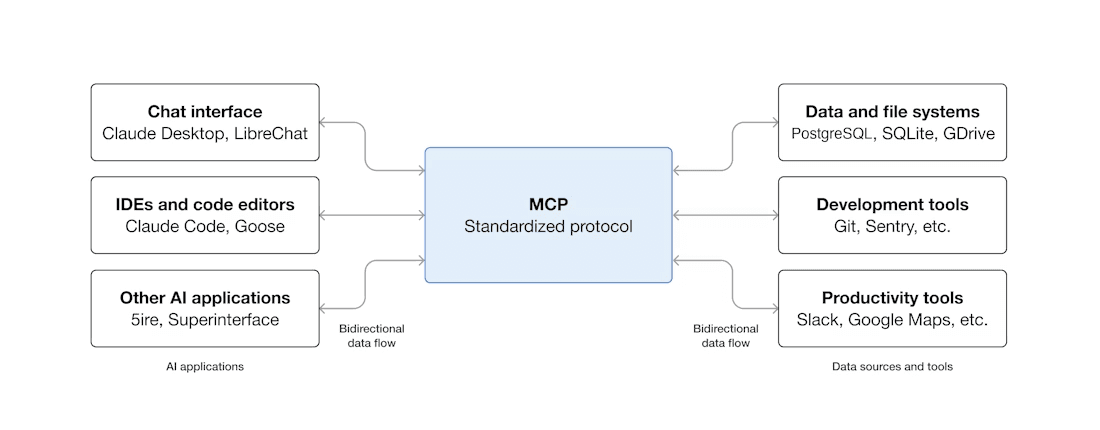
MCP, short for Model Context Protocol, is an emerging standard for connecting AI agents to tools, data sources, and software systems in a more consistent way. Instead of building a separate custom integration for every model, app, or agent framework, teams can use MCP to make those connections more reusable and easier to manage.
That is the core idea.
The reason everyone is building around MCP is not that standards are suddenly exciting on their own. It is that AI agents are becoming tool-using systems, and tool-using systems need a cleaner way to interact with the software around them.
What Does MCP Stand For?
MCP stands for Model Context Protocol.
The name sounds technical, but the concept is easier to understand than it first appears. MCP is meant to give AI systems a more standardized way to access the context and tools they need in order to do useful work.
In practical terms, that can include access to:
files
APIs
databases
internal tools
documentation
business systems
developer environments
workflow platforms
A simple way to think about it is this:
APIs are how software exposes capabilities
MCP is part of an emerging standard for how AI agents can discover and use those capabilities more consistently
That is why MCP keeps showing up in conversations about agent infrastructure.
What Is MCP in Simple Terms?
The simplest answer to what is MCP is:
MCP is a standard way for AI agents to connect to tools and data.
That matters because most useful agents need more than a model. They need access to external systems.
For example, an agent might need to:
search company documentation
pull a customer record
read a support ticket
fetch analytics data
update a CRM
trigger a workflow
inspect a file
use internal business software
Without some common structure, those connections often turn into a patchwork of one-off integrations, framework-specific tooling, and custom logic that is difficult to maintain.
MCP is gaining momentum because it offers a cleaner pattern.
It does not eliminate complexity altogether. But it can reduce some of the repeated integration work that shows up whenever teams try to move from AI demos to real systems.
Why Is MCP Suddenly Everywhere?
MCP is getting attention now because the AI conversation is changing.
Not long ago, most of the focus was on models, prompts, and chatbot interfaces. Now the focus is shifting toward agents that can actually take actions, interact with software, and work across multiple tools.
That shift changes what matters.
When an AI system only needs to generate text, integration standards are less important. Once it needs to retrieve data, use tools, and operate inside business workflows, the connection layer becomes much more important.
More teams are moving from demos to workflows
A basic chatbot can be useful. But businesses increasingly want systems that can do more than answer questions. They want agents that can gather context, interact with systems, and help complete tasks.
That creates new infrastructure needs.
Custom integrations do not scale well
Many early agent projects rely on custom tool wiring. That can work for a prototype, but it becomes painful as the number of tools, systems, and workflows grows.
Every one-off integration creates more maintenance overhead.
The ecosystem is getting more crowded
There are now more models, more frameworks, more agent platforms, and more vendors all trying to become part of the stack. In crowded ecosystems, standards tend to become more valuable.
Teams want more portability
If every integration depends on a specific framework or vendor approach, switching becomes harder. MCP is appealing partly because it suggests a more flexible foundation.
So when people ask why everyone is building around MCP, the answer is mostly this: the market is maturing, and maturing markets usually start to care a lot more about standards.
Why MCP Matters for AI Agents
MCP matters because AI agents are only truly useful when they can work with the systems around them.
A model by itself can generate language. But most business value comes from combining language with access to tools, data, and workflows.
That makes the real question bigger than model quality alone. Teams also have to think about:
how agents access context
how they use tools
how connections are structured
how reusable those integrations are
how difficult they are to maintain over time
This is where MCP becomes relevant.
As agents become more action-oriented, the infrastructure around tool use starts to matter almost as much as the model itself. For businesses, that affects far more than engineering elegance. It can influence deployment speed, maintenance costs, operational consistency, and long-term flexibility.
That is why MCP matters for AI agents specifically. It addresses a real problem in the growing gap between what models can generate and what production systems need to support.

What Problem Does MCP Solve?
The easiest way to understand the Model Context Protocol is to look at the mess it is trying to improve.
Too many one-off integrations
Without a shared approach, teams often rebuild similar connections over and over again. One team wires an agent into a CRM. Another separately connects a model to a document system. A third builds custom tooling for internal search.
That duplication adds up.
Fragmented agent infrastructure
Different frameworks and platforms often have their own way of handling tools, context, and external system access. That fragmentation makes the overall ecosystem harder to work with.
Slower deployment
Custom integrations tend to slow down production rollouts. Prototypes can be built quickly, but reliability, consistency, and maintainability become harder as the number of integrations grows.
Poor reuse
If a tool connection is tightly coupled to one framework, assistant, or vendor stack, it becomes harder to reuse across products or workflows. Standardized patterns can make that easier.
Harder scaling across teams
A messy setup may be manageable for one experiment. It becomes a bigger problem when multiple teams want agents to access shared systems in consistent ways.
That is the practical case for MCP. It is not a miracle technology. It is an attempt to reduce integration sprawl.
How MCP Is Different From Traditional Integrations
Traditional integrations are usually built application by application.
One team writes code to connect an assistant to a knowledge base. Another team separately connects a model to a database. A third creates its own internal tool layer for a workflow agent.
Over time, those decisions create inconsistency.
MCP aims to introduce a more common pattern for how AI systems access tools and context. That can make it easier to build connections that are reusable across different agents and environments.
It is important, though, not to overstate the point.
MCP does not replace the underlying systems. It does not eliminate APIs. And it does not magically remove all integration work.
A better way to think about it is this:
traditional integrations are often custom and isolated
MCP aims to make agent access to tools more standardized and portable
That distinction is why so many teams are paying attention to it.
Why Businesses Care About MCP
Most business leaders do not care about protocol design for its own sake. They care about cost, speed, flexibility, and risk.
That is why MCP matters beyond developer circles.
If it works as intended, MCP can help teams:
reduce duplicate integration work
connect agents to systems more consistently
make infrastructure more reusable
lower dependence on one vendor’s approach
create a cleaner base for future scaling
This is especially relevant for companies that expect to run more than one agent, support more than one workflow, or use more than one model over time.
The more serious an organization gets about AI agents, the less it wants core infrastructure held together by one-off glue code. Standardization becomes attractive not because it sounds advanced, but because it can make operations less fragile.
That said, “can help” is the right phrase here. MCP is promising, but real value depends on implementation quality, governance, and whether it actually fits the team’s use case.
What MCP Does Not Solve
This is the part that gets lost when the conversation becomes too enthusiastic.
MCP may help standardize connections, but it does not solve the hardest parts of deploying agents in production.
MCP does not make agents secure
A common connection layer is not the same thing as strong security. Teams still need:
least-privilege access
approval flows for sensitive actions
logging and auditability
data access controls
prompt injection defenses
outbound restrictions
policy enforcement
If an agent has unsafe permissions, MCP does not fix that.
MCP does not make agents smarter
A protocol cannot compensate for weak reasoning, bad instructions, poor workflow design, or low-quality tools.
If an agent takes the wrong action, standardization alone does not save you.
MCP does not replace governance
Enterprise teams still need monitoring, approvals, controls, and operational oversight. The connection layer is only one piece of a much bigger production system.
MCP does not justify bad architecture
Some teams will still overbuild. MCP may help organize tool access, but it does not mean every multi-agent system is suddenly a good idea.
This is why the most useful way to view MCP is as infrastructure, not as a silver bullet.
MCP vs APIs: Are They Competing?
Not really.
This is one of the easiest places for confusion to creep in.
APIs are still the core mechanism many systems use to expose functionality. MCP does not replace that. Instead, it sits closer to the question of how AI agents can interact with those capabilities in a more standardized way.
So the comparison is not:
MCP or APIs
It is more like:
APIs remain the underlying interfaces
MCP helps define a cleaner way for agents to use them
That makes MCP much easier to understand. It is not trying to erase existing software architecture. It is trying to make agent interaction with that architecture less fragmented.
MCP vs A2A: What Is the Difference?
Another reason people search for MCP explained content is that MCP often gets mixed up with other emerging standards and concepts.
A simple distinction is:
MCP is mostly about agent-to-tool and agent-to-data connections
A2A is about agent-to-agent communication
They solve different problems.
If your question is, “How does this agent access files, systems, or business tools?” you are in MCP territory.
If your question is, “How do multiple agents coordinate, delegate, or exchange tasks?” you are in A2A territory.
Some companies may end up using both. But they should not be treated as interchangeable. MCP is about connecting agents to external systems. A2A is about connecting agents to each other.
That is an important distinction, especially for teams trying to make sense of the emerging agent stack.
Should Your Team Care About MCP Right Now?
The honest answer is: it depends on where you are.
Your team should probably care if:
you are building agents that need tool access
you expect multiple integrations
you want reusable infrastructure
you are moving beyond a prototype
you care about long-term portability
Your team probably does not need to obsess over MCP yet if:
you are still validating the use case
your workflow is very narrow
you only have one simple integration
you are still in experimentation mode
In other words, MCP matters most when the integration problem becomes real.
That is why interest is rising now. More teams are reaching the point where building useful agents requires more structure than ad hoc tooling can provide.
Why More of the Ecosystem Is Building Around MCP
The short answer is that MCP sits in the middle of an increasingly important problem.
As AI agents become more capable, they need better ways to interact with:
business systems
internal knowledge
structured data
developer tools
workflow engines
external services
operational software
That makes the connection layer strategically important.
Vendors, developers, and platform teams are building around MCP because they want a more standard way to support those interactions. If enough of the ecosystem aligns around that approach, it becomes easier to build tools, platforms, and products that work together.
That does not guarantee MCP becomes the final answer. Standards still need adoption, implementation quality, and staying power.
But the direction of travel is clear: the AI agent market is shifting from model novelty to infrastructure maturity.
And when that happens, standards become much more important.

The Bigger Takeaway
If you remember one thing from this article, let it be this:
MCP matters because AI agents are becoming tool-using systems, and tool-using systems need a more standardized way to connect to the software around them.
That is the real reason people care.
The hype around MCP will probably overshoot at times, as hype usually does. But the underlying need is real. As teams move from one-off copilots to systems that operate inside real workflows, they need cleaner ways to connect agents to tools, data, and business software.
That is why more of the ecosystem is building around MCP.
Not because protocols are inherently exciting.
Because useful agents need better infrastructure.
FAQ
What is MCP in AI?
MCP in AI usually refers to Model Context Protocol, an emerging standard for connecting AI agents to tools, data sources, and software systems in a more consistent way.
What does MCP stand for?
MCP stands for Model Context Protocol.
What is the Model Context Protocol?
The Model Context Protocol is a standard designed to help AI systems access tools, data, and context more consistently instead of relying entirely on one-off integrations.
Why is MCP important for AI agents?
MCP is important for AI agents because useful agents often need access to files, APIs, databases, internal tools, and business systems. A more standardized approach can make those connections easier to build and reuse.
Does MCP replace APIs?
No. APIs still expose the underlying capabilities of software systems. MCP is better understood as a way to help agents interact with those systems more consistently.
Is MCP only for developers?
Developers will care most about implementation details, but business and product teams should care too. MCP can affect integration speed, scalability, and long-term flexibility in the agent stack.
Does MCP make AI agents more secure?
No. MCP does not automatically make agents secure. Teams still need strong permissions, policy controls, approval steps, logging, and security guardrails.
What is the difference between MCP and A2A?
A simple way to think about it is:
MCP = agent-to-tool and agent-to-data connections
A2A = agent-to-agent communication
They address different parts of the agent stack.
AI agents are becoming more useful, but also more connected.
They no longer just answer questions. They search knowledge bases, access files, call APIs, retrieve data from internal systems, and trigger workflows. As that shift happens, one question keeps coming up: how should agents connect to the tools and systems where real work happens?
That is a big reason more people are asking: what is MCP?
MCP, short for Model Context Protocol, is an emerging standard for connecting AI agents to tools, data sources, and software systems in a more consistent way. Instead of building a separate custom integration for every model, app, or agent framework, teams can use MCP to make those connections more reusable and easier to manage.
That is the core idea.
The reason everyone is building around MCP is not that standards are suddenly exciting on their own. It is that AI agents are becoming tool-using systems, and tool-using systems need a cleaner way to interact with the software around them.
What Does MCP Stand For?
MCP stands for Model Context Protocol.
The name sounds technical, but the concept is easier to understand than it first appears. MCP is meant to give AI systems a more standardized way to access the context and tools they need in order to do useful work.
In practical terms, that can include access to:
files
APIs
databases
internal tools
documentation
business systems
developer environments
workflow platforms
A simple way to think about it is this:
APIs are how software exposes capabilities
MCP is part of an emerging standard for how AI agents can discover and use those capabilities more consistently
That is why MCP keeps showing up in conversations about agent infrastructure.
What Is MCP in Simple Terms?
The simplest answer to what is MCP is:
MCP is a standard way for AI agents to connect to tools and data.
That matters because most useful agents need more than a model. They need access to external systems.
For example, an agent might need to:
search company documentation
pull a customer record
read a support ticket
fetch analytics data
update a CRM
trigger a workflow
inspect a file
use internal business software
Without some common structure, those connections often turn into a patchwork of one-off integrations, framework-specific tooling, and custom logic that is difficult to maintain.
MCP is gaining momentum because it offers a cleaner pattern.
It does not eliminate complexity altogether. But it can reduce some of the repeated integration work that shows up whenever teams try to move from AI demos to real systems.
Why Is MCP Suddenly Everywhere?
MCP is getting attention now because the AI conversation is changing.
Not long ago, most of the focus was on models, prompts, and chatbot interfaces. Now the focus is shifting toward agents that can actually take actions, interact with software, and work across multiple tools.
That shift changes what matters.
When an AI system only needs to generate text, integration standards are less important. Once it needs to retrieve data, use tools, and operate inside business workflows, the connection layer becomes much more important.
More teams are moving from demos to workflows
A basic chatbot can be useful. But businesses increasingly want systems that can do more than answer questions. They want agents that can gather context, interact with systems, and help complete tasks.
That creates new infrastructure needs.
Custom integrations do not scale well
Many early agent projects rely on custom tool wiring. That can work for a prototype, but it becomes painful as the number of tools, systems, and workflows grows.
Every one-off integration creates more maintenance overhead.
The ecosystem is getting more crowded
There are now more models, more frameworks, more agent platforms, and more vendors all trying to become part of the stack. In crowded ecosystems, standards tend to become more valuable.
Teams want more portability
If every integration depends on a specific framework or vendor approach, switching becomes harder. MCP is appealing partly because it suggests a more flexible foundation.
So when people ask why everyone is building around MCP, the answer is mostly this: the market is maturing, and maturing markets usually start to care a lot more about standards.
Why MCP Matters for AI Agents
MCP matters because AI agents are only truly useful when they can work with the systems around them.
A model by itself can generate language. But most business value comes from combining language with access to tools, data, and workflows.
That makes the real question bigger than model quality alone. Teams also have to think about:
how agents access context
how they use tools
how connections are structured
how reusable those integrations are
how difficult they are to maintain over time
This is where MCP becomes relevant.
As agents become more action-oriented, the infrastructure around tool use starts to matter almost as much as the model itself. For businesses, that affects far more than engineering elegance. It can influence deployment speed, maintenance costs, operational consistency, and long-term flexibility.
That is why MCP matters for AI agents specifically. It addresses a real problem in the growing gap between what models can generate and what production systems need to support.
What Problem Does MCP Solve?
The easiest way to understand the Model Context Protocol is to look at the mess it is trying to improve.
Too many one-off integrations
Without a shared approach, teams often rebuild similar connections over and over again. One team wires an agent into a CRM. Another separately connects a model to a document system. A third builds custom tooling for internal search.
That duplication adds up.
Fragmented agent infrastructure
Different frameworks and platforms often have their own way of handling tools, context, and external system access. That fragmentation makes the overall ecosystem harder to work with.
Slower deployment
Custom integrations tend to slow down production rollouts. Prototypes can be built quickly, but reliability, consistency, and maintainability become harder as the number of integrations grows.
Poor reuse
If a tool connection is tightly coupled to one framework, assistant, or vendor stack, it becomes harder to reuse across products or workflows. Standardized patterns can make that easier.
Harder scaling across teams
A messy setup may be manageable for one experiment. It becomes a bigger problem when multiple teams want agents to access shared systems in consistent ways.
That is the practical case for MCP. It is not a miracle technology. It is an attempt to reduce integration sprawl.
How MCP Is Different From Traditional Integrations
Traditional integrations are usually built application by application.
One team writes code to connect an assistant to a knowledge base. Another team separately connects a model to a database. A third creates its own internal tool layer for a workflow agent.
Over time, those decisions create inconsistency.
MCP aims to introduce a more common pattern for how AI systems access tools and context. That can make it easier to build connections that are reusable across different agents and environments.
It is important, though, not to overstate the point.
MCP does not replace the underlying systems. It does not eliminate APIs. And it does not magically remove all integration work.
A better way to think about it is this:
traditional integrations are often custom and isolated
MCP aims to make agent access to tools more standardized and portable
That distinction is why so many teams are paying attention to it.
Why Businesses Care About MCP
Most business leaders do not care about protocol design for its own sake. They care about cost, speed, flexibility, and risk.
That is why MCP matters beyond developer circles.
If it works as intended, MCP can help teams:
reduce duplicate integration work
connect agents to systems more consistently
make infrastructure more reusable
lower dependence on one vendor’s approach
create a cleaner base for future scaling
This is especially relevant for companies that expect to run more than one agent, support more than one workflow, or use more than one model over time.
The more serious an organization gets about AI agents, the less it wants core infrastructure held together by one-off glue code. Standardization becomes attractive not because it sounds advanced, but because it can make operations less fragile.
That said, “can help” is the right phrase here. MCP is promising, but real value depends on implementation quality, governance, and whether it actually fits the team’s use case.
What MCP Does Not Solve
This is the part that gets lost when the conversation becomes too enthusiastic.
MCP may help standardize connections, but it does not solve the hardest parts of deploying agents in production.
MCP does not make agents secure
A common connection layer is not the same thing as strong security. Teams still need:
least-privilege access
approval flows for sensitive actions
logging and auditability
data access controls
prompt injection defenses
outbound restrictions
policy enforcement
If an agent has unsafe permissions, MCP does not fix that.
MCP does not make agents smarter
A protocol cannot compensate for weak reasoning, bad instructions, poor workflow design, or low-quality tools.
If an agent takes the wrong action, standardization alone does not save you.
MCP does not replace governance
Enterprise teams still need monitoring, approvals, controls, and operational oversight. The connection layer is only one piece of a much bigger production system.
MCP does not justify bad architecture
Some teams will still overbuild. MCP may help organize tool access, but it does not mean every multi-agent system is suddenly a good idea.
This is why the most useful way to view MCP is as infrastructure, not as a silver bullet.
MCP vs APIs: Are They Competing?
Not really.
This is one of the easiest places for confusion to creep in.
APIs are still the core mechanism many systems use to expose functionality. MCP does not replace that. Instead, it sits closer to the question of how AI agents can interact with those capabilities in a more standardized way.
So the comparison is not:
MCP or APIs
It is more like:
APIs remain the underlying interfaces
MCP helps define a cleaner way for agents to use them
That makes MCP much easier to understand. It is not trying to erase existing software architecture. It is trying to make agent interaction with that architecture less fragmented.
MCP vs A2A: What Is the Difference?
Another reason people search for MCP explained content is that MCP often gets mixed up with other emerging standards and concepts.
A simple distinction is:
MCP is mostly about agent-to-tool and agent-to-data connections
A2A is about agent-to-agent communication
They solve different problems.
If your question is, “How does this agent access files, systems, or business tools?” you are in MCP territory.
If your question is, “How do multiple agents coordinate, delegate, or exchange tasks?” you are in A2A territory.
Some companies may end up using both. But they should not be treated as interchangeable. MCP is about connecting agents to external systems. A2A is about connecting agents to each other.
That is an important distinction, especially for teams trying to make sense of the emerging agent stack.
Should Your Team Care About MCP Right Now?
The honest answer is: it depends on where you are.
Your team should probably care if:
you are building agents that need tool access
you expect multiple integrations
you want reusable infrastructure
you are moving beyond a prototype
you care about long-term portability
Your team probably does not need to obsess over MCP yet if:
you are still validating the use case
your workflow is very narrow
you only have one simple integration
you are still in experimentation mode
In other words, MCP matters most when the integration problem becomes real.
That is why interest is rising now. More teams are reaching the point where building useful agents requires more structure than ad hoc tooling can provide.
Why More of the Ecosystem Is Building Around MCP
The short answer is that MCP sits in the middle of an increasingly important problem.
As AI agents become more capable, they need better ways to interact with:
business systems
internal knowledge
structured data
developer tools
workflow engines
external services
operational software
That makes the connection layer strategically important.
Vendors, developers, and platform teams are building around MCP because they want a more standard way to support those interactions. If enough of the ecosystem aligns around that approach, it becomes easier to build tools, platforms, and products that work together.
That does not guarantee MCP becomes the final answer. Standards still need adoption, implementation quality, and staying power.
But the direction of travel is clear: the AI agent market is shifting from model novelty to infrastructure maturity.
And when that happens, standards become much more important.
The Bigger Takeaway
If you remember one thing from this article, let it be this:
MCP matters because AI agents are becoming tool-using systems, and tool-using systems need a more standardized way to connect to the software around them.
That is the real reason people care.
The hype around MCP will probably overshoot at times, as hype usually does. But the underlying need is real. As teams move from one-off copilots to systems that operate inside real workflows, they need cleaner ways to connect agents to tools, data, and business software.
That is why more of the ecosystem is building around MCP.
Not because protocols are inherently exciting.
Because useful agents need better infrastructure.
FAQ
What is MCP in AI?
MCP in AI usually refers to Model Context Protocol, an emerging standard for connecting AI agents to tools, data sources, and software systems in a more consistent way.
What does MCP stand for?
MCP stands for Model Context Protocol.
What is the Model Context Protocol?
The Model Context Protocol is a standard designed to help AI systems access tools, data, and context more consistently instead of relying entirely on one-off integrations.
Why is MCP important for AI agents?
MCP is important for AI agents because useful agents often need access to files, APIs, databases, internal tools, and business systems. A more standardized approach can make those connections easier to build and reuse.
Does MCP replace APIs?
No. APIs still expose the underlying capabilities of software systems. MCP is better understood as a way to help agents interact with those systems more consistently.
Is MCP only for developers?
Developers will care most about implementation details, but business and product teams should care too. MCP can affect integration speed, scalability, and long-term flexibility in the agent stack.
Does MCP make AI agents more secure?
No. MCP does not automatically make agents secure. Teams still need strong permissions, policy controls, approval steps, logging, and security guardrails.
What is the difference between MCP and A2A?
A simple way to think about it is:
MCP = agent-to-tool and agent-to-data connections
A2A = agent-to-agent communication
They address different parts of the agent stack.
Guide
What Is MCP? Why Everyone Is Building Around the Model Context Protocol