

Meet Nicklas Scharpff, a former future-bass producer turned software engineer and open-source builder.
From shipping tracks as Halcyon to contributing to Vercel AI Elements and creating TokenLens, Nicklas brings a rare mix of creative intuition and product-minded engineering to the next wave of AI developer tools.
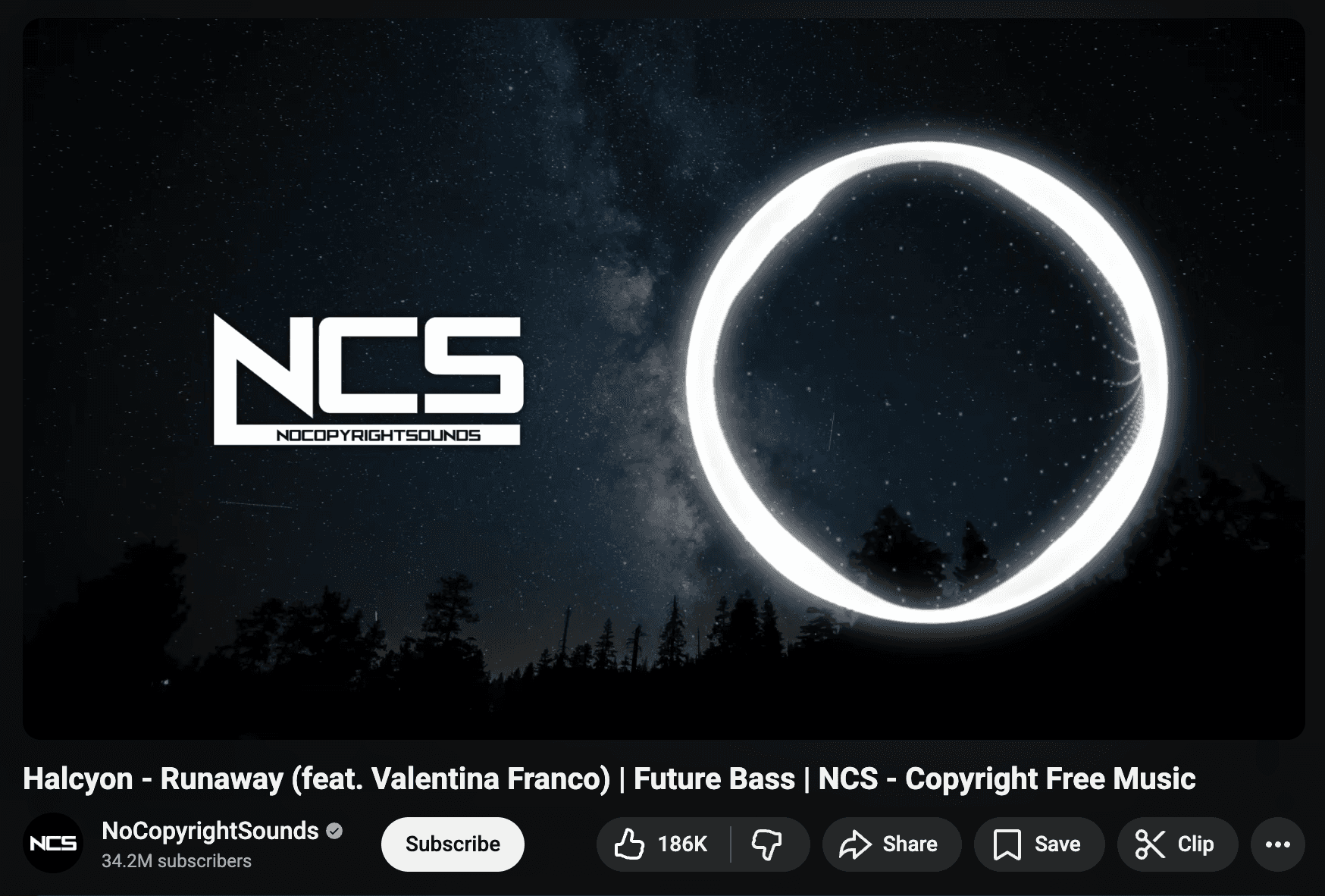
You started as a musician in your teens, even releasing the track “Runaway” under Halcyon on NoCopyrightSounds.
What was that chapter like, and how did you transition from producing future bass to becoming a software engineer?
During the school holidays I often felt bored, with most of my friends away on family vacations. In the autumn break of 2012, I installed a demo version of FL Studio and just started messing around.
My first attempts were terrible. I even got mocked in class for how “unmusical” I was, but I kept going, kept learning, and kept shipping tracks. Eventually I won a remix competition by Hardwell’s label Revealed Records with my remix of Freeze Time by Manse.
My music career peaked in 2017 with my song Runaway, and by then I felt creatively burned out and uninspired. I had just finished high school and wanted to explore other directions, which led to a (still ongoing) pause from producing.
This whole phase left me with a deep connection to my creative instincts. Music taught me to trust my intuition, and that’s something I now consider one of my strongest skills when building software.
What first drew you into programming and AI after your music days?
Coding felt like a counterbalance to the creative challenges I was facing at the end of my music chapter. Code tends to be right or wrong, it compiles or it doesn’t, which was refreshing after spending weeks iterating on a single melody.
There are a lot of parallels between producing a song and building software. As a producer, I often collaborated with singers, drummers, or guitarists for parts I couldn’t or shouldn’t produce myself.
In software, an app is a composition too: it needs frontend, backend, infrastructure, design, all working in harmony.
These analogies helped me find my place in teams, often acting like the “composer” of an application. This role feels like the most natural place for me to be.
You contributed to Vercel AI Elements. Would you like to share more about that?
I took a break from freelancing this summer to spend more time contributing to open-source projects.
After building multiple AI-powered SaaS applications, I realized I had a collection of components that might be useful for Vercel’s AI Elements.
I shared some of them with Hayden (the creator of AI Elements), and it was a really fun collaboration. He helped me refine the components to match the vision and DX of the library.
I ended up building the Context component and adding the attachment uploader and viewer to the PromptInput, features that now ship to hundreds of thousands of users.
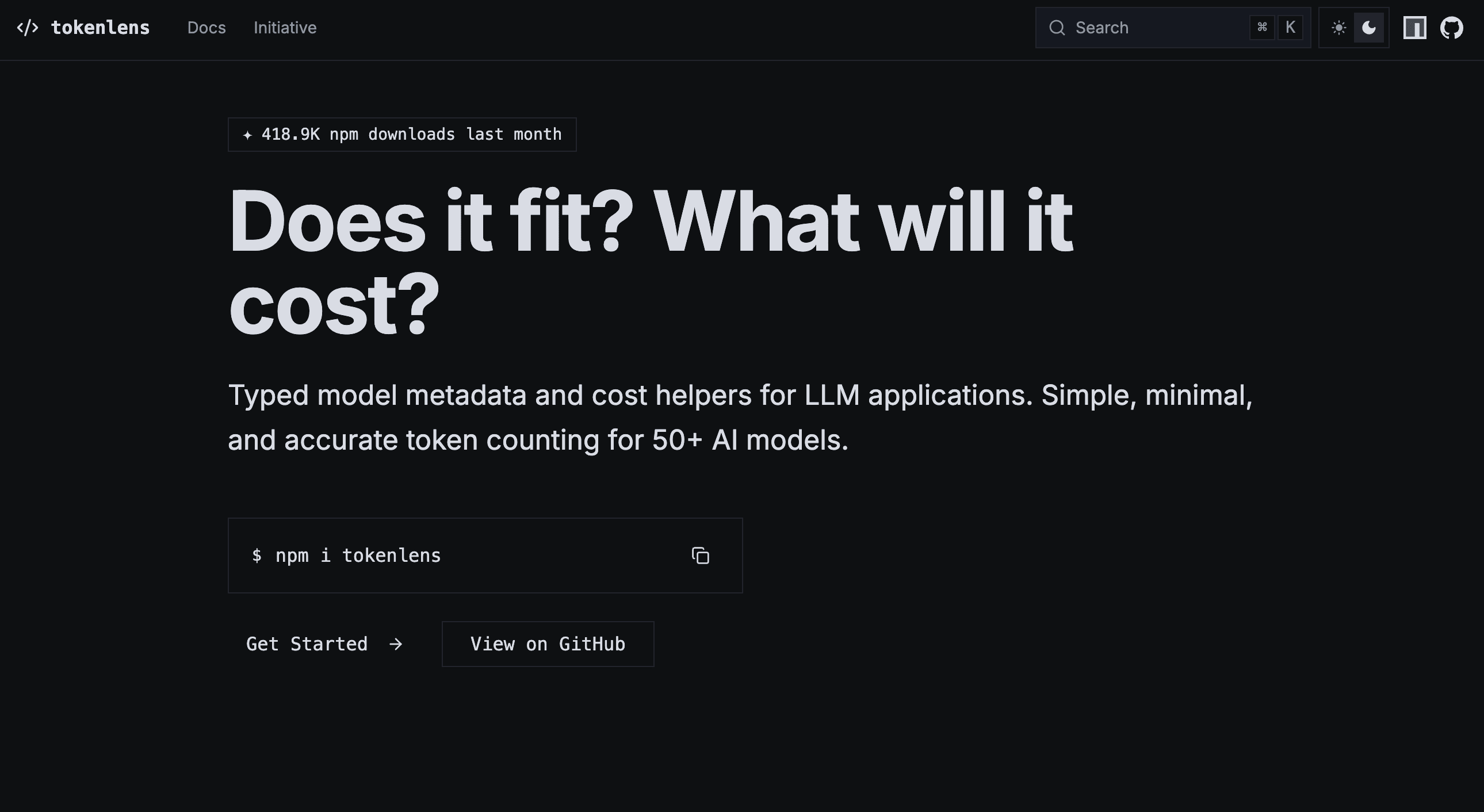
Tell us about TokenLens, your open-source NPM package for token counting and cost estimation in AI applications.
What inspired you to build it, and how has it been received with over 300K downloads last month?
While contributing to AI Elements, I wondered what new components I could build. Cursor had a context indicator that caught my attention, and I wanted to create something similar for AI Elements. The UI part was simple, but getting the data was not straightforward.
Responses from AI Elements typically include token usage but not the cost per token or the model’s maximum context window. This DX gap inspired me to solve the problem, which led to Tokenlens.
I'm still surprised this is such a common need, and that AI providers haven’t integrated native solutions into their APIs yet.
You've shared how open-source work like TokenLens helped you land dev jobs.
What are your general thoughts on using open-source contributions to break into the industry?
Open source has multiple advantages. It transparently shows how you work: how you structure code, your engineering taste, your communication style, and how you respond to feedback, all crucial skills.
And it makes your work visible to the world, which means potential employers and collaborators can find you.
People often say open source is “working for free,” but that’s not true, the reward just isn’t instant. The benefits compound over time through opportunities, sponsorship, or funding.
Yes, it sometimes means you need to live from savings or work part-time in the meantime. But investing in myself always paid off. My advice: be curious and ship. The rest follows.
What pushed you to become a Cursor Ambassador and what does that imply?
When we built Stagewise, we were very involved with the Cursor community, our announcement post even passed 100k views in the Cursor Community on X.
I initially applied to the Ambassador program to help push Stagewise, but by the time I was accepted, I was no longer operationally part of the company.
Still, the Cursor team, especially Ben Lang, showed so much excitement about what we were building that I naturally started rooting for them.
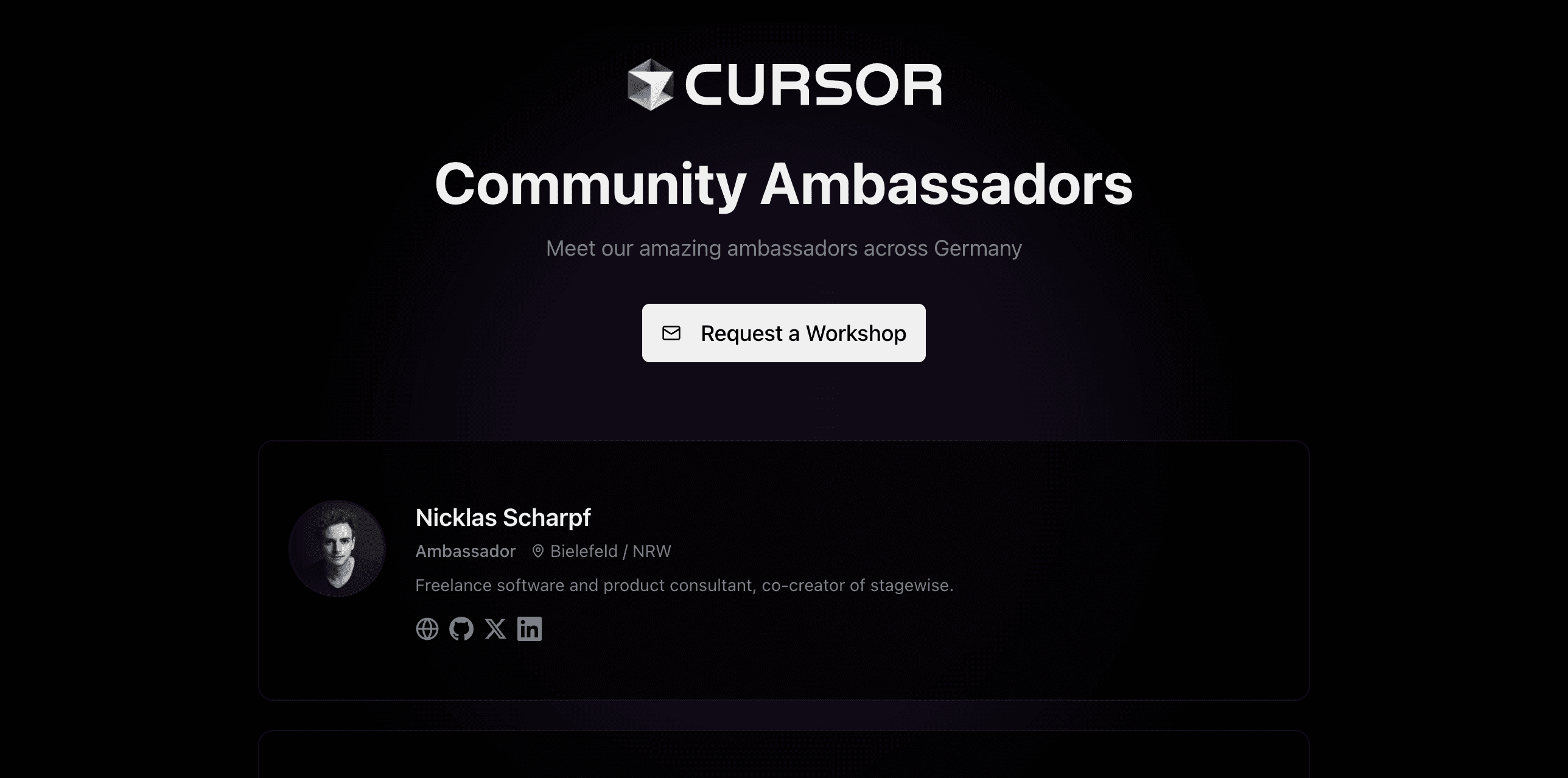
As a Cursor Ambassador, I organize events across Germany, from hackathons to meetups to office hours with Cursor staff. We’ve already done events in Hamburg, Berlin, and Munich.
Your startup stagewise got launched in April and accepted into YC S25.
What problem does stagewise solve as a frontend coding agent for production codebases?
Stagewise is the startup of my good friends Glenn and Julian. When I met them, they were close to abandoning it.
The original product was a QA tool, a browser extension that let designers and PMs annotate HTML elements to give feedback to developers.
I convinced them that the underlying technology was powerful and deserved to be open-sourced to spark serendipity.
Around that time we were working heavily in Cursor, and we kept thinking:
“It’s tedious to manually mention files to Cursor. What if we could just click on components in the browser and forward them directly?”
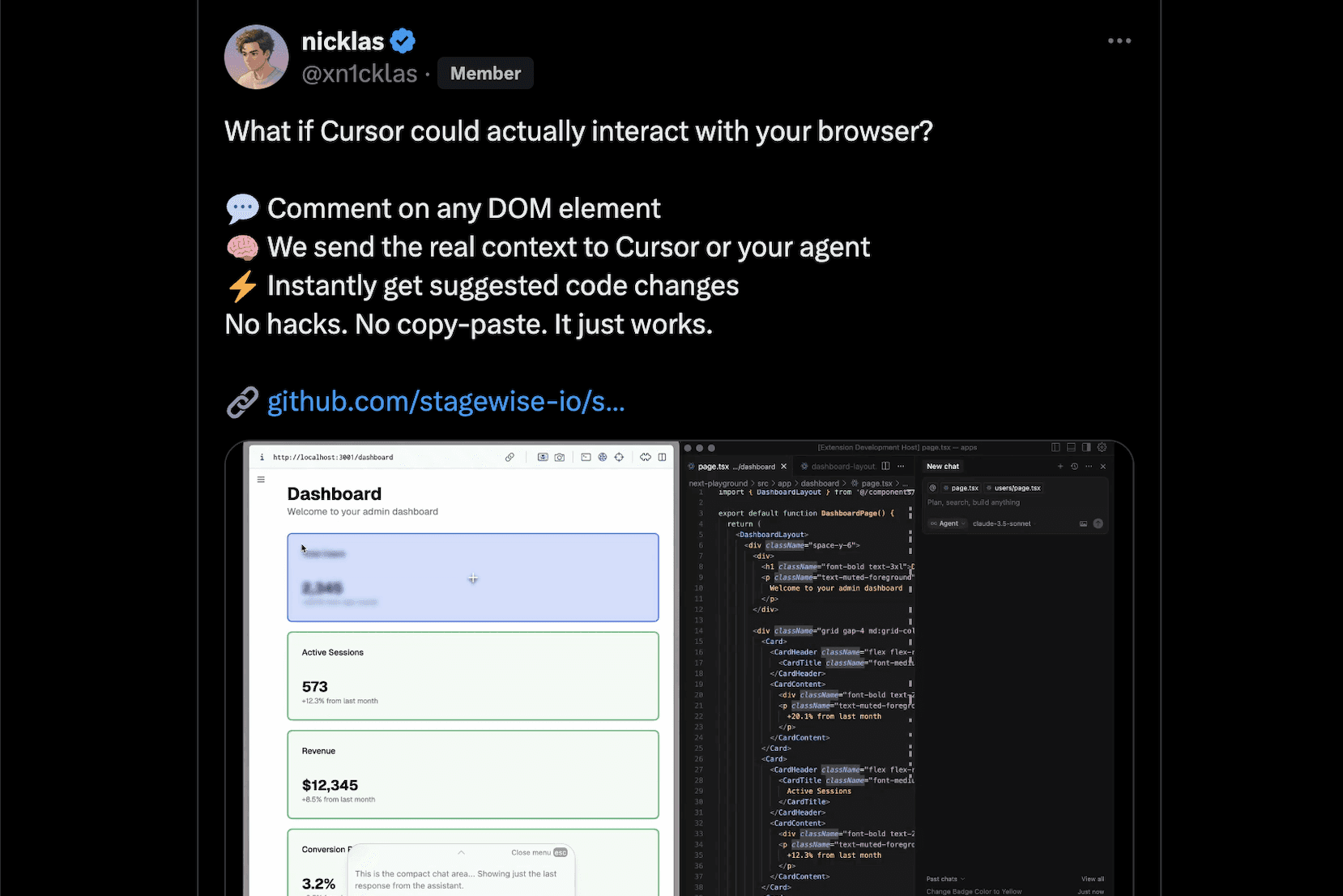
After some experimenting, Julian came up with a very unconventional approach to essentially “hijack” Cursor and inject an HTML element from the browser into it.
This allowed us to build a minimal prompt input directly on top of the user’s UI. Developers could click any component in the browser and send it, with a prompt, straight to Cursor. It removed the friction of tabbing back to the IDE and searching for filenames.
It meant frontend developers could iterate visually and instantly with an AI agent, right where their UI lives.
Looking ahead, what are you planning to focus on in the next chapter?
I’m very bullish on AI innovation, and I see user-centric product design as a fundamental requirement to unlock what’s possible.
I want to build teams with strong product intuition and work on tools that push the next wave of AI-driven development forward.
And finally, what advice would you give aspiring developers or AI builders navigating open source, ambassadorships, startup side projects, or YC?
Find something that genuinely sparks your curiosity. When you follow that pull, you unlock almost supernatural levels of focus and energy. Success becomes a byproduct.
Want to share your own story with the Agent.so community? Reach out and tell us what you’re building, what you’ve learned, and what you’re excited about, we’d love to feature you in an upcoming interview.
Meet Nicklas Scharpff, a former future-bass producer turned software engineer and open-source builder.
From shipping tracks as Halcyon to contributing to Vercel AI Elements and creating TokenLens, Nicklas brings a rare mix of creative intuition and product-minded engineering to the next wave of AI developer tools.
You started as a musician in your teens, even releasing the track “Runaway” under Halcyon on NoCopyrightSounds.
What was that chapter like, and how did you transition from producing future bass to becoming a software engineer?
During the school holidays I often felt bored, with most of my friends away on family vacations. In the autumn break of 2012, I installed a demo version of FL Studio and just started messing around.
My first attempts were terrible. I even got mocked in class for how “unmusical” I was, but I kept going, kept learning, and kept shipping tracks. Eventually I won a remix competition by Hardwell’s label Revealed Records with my remix of Freeze Time by Manse.
My music career peaked in 2017 with my song Runaway, and by then I felt creatively burned out and uninspired. I had just finished high school and wanted to explore other directions, which led to a (still ongoing) pause from producing.
This whole phase left me with a deep connection to my creative instincts. Music taught me to trust my intuition, and that’s something I now consider one of my strongest skills when building software.
What first drew you into programming and AI after your music days?
Coding felt like a counterbalance to the creative challenges I was facing at the end of my music chapter. Code tends to be right or wrong, it compiles or it doesn’t, which was refreshing after spending weeks iterating on a single melody.
There are a lot of parallels between producing a song and building software. As a producer, I often collaborated with singers, drummers, or guitarists for parts I couldn’t or shouldn’t produce myself.
In software, an app is a composition too: it needs frontend, backend, infrastructure, design, all working in harmony.
These analogies helped me find my place in teams, often acting like the “composer” of an application. This role feels like the most natural place for me to be.
You contributed to Vercel AI Elements. Would you like to share more about that?
I took a break from freelancing this summer to spend more time contributing to open-source projects.
After building multiple AI-powered SaaS applications, I realized I had a collection of components that might be useful for Vercel’s AI Elements.
I shared some of them with Hayden (the creator of AI Elements), and it was a really fun collaboration. He helped me refine the components to match the vision and DX of the library.
I ended up building the Context component and adding the attachment uploader and viewer to the PromptInput, features that now ship to hundreds of thousands of users.
Tell us about TokenLens, your open-source NPM package for token counting and cost estimation in AI applications.
What inspired you to build it, and how has it been received with over 300K downloads last month?
While contributing to AI Elements, I wondered what new components I could build. Cursor had a context indicator that caught my attention, and I wanted to create something similar for AI Elements. The UI part was simple, but getting the data was not straightforward.
Responses from AI Elements typically include token usage but not the cost per token or the model’s maximum context window. This DX gap inspired me to solve the problem, which led to Tokenlens.
I'm still surprised this is such a common need, and that AI providers haven’t integrated native solutions into their APIs yet.
You've shared how open-source work like TokenLens helped you land dev jobs.
What are your general thoughts on using open-source contributions to break into the industry?
Open source has multiple advantages. It transparently shows how you work: how you structure code, your engineering taste, your communication style, and how you respond to feedback, all crucial skills.
And it makes your work visible to the world, which means potential employers and collaborators can find you.
People often say open source is “working for free,” but that’s not true, the reward just isn’t instant. The benefits compound over time through opportunities, sponsorship, or funding.
Yes, it sometimes means you need to live from savings or work part-time in the meantime. But investing in myself always paid off. My advice: be curious and ship. The rest follows.
What pushed you to become a Cursor Ambassador and what does that imply?
When we built Stagewise, we were very involved with the Cursor community, our announcement post even passed 100k views in the Cursor Community on X.
I initially applied to the Ambassador program to help push Stagewise, but by the time I was accepted, I was no longer operationally part of the company.
Still, the Cursor team, especially Ben Lang, showed so much excitement about what we were building that I naturally started rooting for them.
As a Cursor Ambassador, I organize events across Germany, from hackathons to meetups to office hours with Cursor staff. We’ve already done events in Hamburg, Berlin, and Munich.
Your startup stagewise got launched in April and accepted into YC S25.
What problem does stagewise solve as a frontend coding agent for production codebases?
Stagewise is the startup of my good friends Glenn and Julian. When I met them, they were close to abandoning it.
The original product was a QA tool, a browser extension that let designers and PMs annotate HTML elements to give feedback to developers.
I convinced them that the underlying technology was powerful and deserved to be open-sourced to spark serendipity.
Around that time we were working heavily in Cursor, and we kept thinking:
“It’s tedious to manually mention files to Cursor. What if we could just click on components in the browser and forward them directly?”
After some experimenting, Julian came up with a very unconventional approach to essentially “hijack” Cursor and inject an HTML element from the browser into it.
This allowed us to build a minimal prompt input directly on top of the user’s UI. Developers could click any component in the browser and send it, with a prompt, straight to Cursor. It removed the friction of tabbing back to the IDE and searching for filenames.
It meant frontend developers could iterate visually and instantly with an AI agent, right where their UI lives.
Looking ahead, what are you planning to focus on in the next chapter?
I’m very bullish on AI innovation, and I see user-centric product design as a fundamental requirement to unlock what’s possible.
I want to build teams with strong product intuition and work on tools that push the next wave of AI-driven development forward.
And finally, what advice would you give aspiring developers or AI builders navigating open source, ambassadorships, startup side projects, or YC?
Find something that genuinely sparks your curiosity. When you follow that pull, you unlock almost supernatural levels of focus and energy. Success becomes a byproduct.
Want to share your own story with the Agent.so community? Reach out and tell us what you’re building, what you’ve learned, and what you’re excited about, we’d love to feature you in an upcoming interview.
Interview
Nicklas Scharpff: From Electronic Dance Music to AI Codebases