

E-commerce does not struggle because of lack of traffic. It struggles because of friction.
Customers arrive on your store. They browse. They hesitate. They abandon. Not because they dislike your products, but because something in the experience feels unclear, overwhelming, or impersonal.
This is where AI agents in e-commerce are becoming a serious competitive advantage.
AI automation for e-commerce is not about adding a chatbot. It is about reducing friction across product discovery, personalization, support, checkout, and retention. When implemented correctly, AI agents for online stores create clarity at scale.
Let’s break down how to use AI agents in e-commerce in a way that actually drives revenue.
AI Agents as the Intelligence Layer in Online Stores
Most ecommerce platforms already collect enormous amounts of data.
Shopify analytics tracks product performance.
Google Analytics 4 tracks user behavior.
Klaviyo tracks email engagement.
Stripe tracks revenue and payment patterns.
But these tools report numbers. They do not interpret behavior.
AI agents for e-commerce act as an intelligence layer on top of that data. Instead of staring at dashboards, you can ask structured questions:
Why did conversion drop in this category?
Why are returning visitors converting less this month?
Why are certain products generating traffic but not sales?
AI workflow automation for e-commerce becomes powerful when it connects behavior with insight and then with action. This is the shift from passive analytics to active optimization.
Improving Product Discovery With AI Shopping Assistants
As ecommerce catalogs grow, navigation becomes harder. Too many filters. Too many options. Too much scrolling.
Choice overload reduces conversions.
AI shopping assistants solve this by guiding customers through structured discovery. Instead of manually browsing dozens of products, customers answer simple intent-driven questions and receive focused recommendations.
This is one of the fastest ways AI agents in e-commerce can improve user experience and increase average order value.
For this to work properly, product data must be structured. In Shopify or WooCommerce, product attributes, tags, and categories must be clean and consistent. AI personalization in ecommerce relies on high quality inputs.
If your catalog structure is messy, fix it first. AI amplifies structure. It does not create it.
When AI powered discovery is aligned with clean product metadata, bounce rates decrease and decision time shortens. That directly improves ecommerce conversion rates.

AI Personalization in E-Commerce That Feels Intelligent
Most ecommerce personalization is still rule-based. If you bought X, you might like Y.
Real AI personalization in ecommerce goes deeper.
AI agents can analyze browsing behavior, cart abandonment patterns, purchase history, time between purchases, and even engagement signals from email campaigns.
For example, if a customer frequently views premium items but abandons at checkout, AI can trigger reassurance messaging around quality, guarantees, or testimonials instead of pushing discounts.
If a customer reorders every 45 days, AI can automate lifecycle messaging before they run out.
Tools like Klaviyo, Customer.io, or Shopify Flow provide the automation backbone. AI agents interpret patterns and guide optimization decisions.
AI automation for online stores works best when personalization is behavioral, not generic.
When relevance increases, conversion rate and customer lifetime value follow.
AI Agents Turn Customer Support Into Retention Infrastructure
In e-commerce, customer support is not just a cost center. It is a diagnostic tool.
Every refund request, sizing question, shipping complaint, or return inquiry reveals friction in your customer experience. Most stores treat these interactions as isolated tickets. The smarter approach is to treat them as data.
This is where AI agents for ecommerce customer support become powerful.
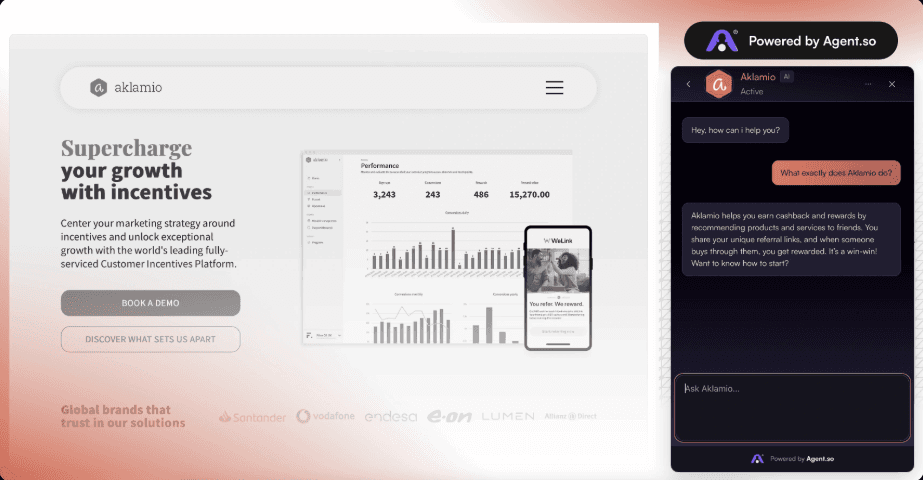
Instead of relying solely on backend helpdesk tools, you can deploy AI Agent Widgets directly on your store. With Agent.so, these AI widgets live on product pages, checkout flows, and support sections. They answer questions in real time, based on your policies, product data, and brand tone.
That changes the timing of support. Instead of reacting after frustration, you intercept hesitation before it becomes abandonment.
For example, if a customer is unsure about sizing, the AI Agent can clarify instantly on the product page. If shipping timelines cause doubt, the agent can explain delivery expectations before checkout. If return policies feel unclear, the AI Agent can simplify them in context.
This reduces ticket volume at the source. If you need help setting up you AI Agent Widget, check out the Agent.so Experts that are ready to assist you.
Reducing Cart Abandonment With AI Driven Insight
Cart abandonment remains one of the largest leaks in ecommerce revenue.
Many stores react with blanket discount codes. That treats the symptom, not the cause.
AI agents can analyze funnel behavior using data from Google Analytics 4, Shopify checkout reports, and Stripe payment logs.
If abandonment spikes after shipping cost visibility, the issue is transparency.
If mobile abandonment is higher than desktop, the issue may be UX friction.
If certain products have higher drop-off, the issue may be perceived value.
AI automation for e-commerce should prioritize friction removal over discounting. When uncertainty decreases, conversion increases without eroding margin.
Post Purchase AI and Customer Lifetime Value
Acquisition is expensive. Retention is compounding.
AI agents in e-commerce can analyze purchase intervals and predict when a customer is likely to reorder. They can identify churn risk and surface cross-sell opportunities based on behavior patterns.
Instead of sending generic promotional emails, AI powered lifecycle campaigns deliver context aware messaging.
If you use Klaviyo or Customer.io, combine segmentation with AI pattern interpretation. If you run subscriptions through Recharge, integrate reorder predictions into email flows.
AI for ecommerce growth becomes exponential when lifetime value increases. Retention stabilizes revenue. Stability compounds growth.
Implementing AI Automation Without Overcomplicating Your Stack
The biggest mistake ecommerce brands make is layering disconnected AI tools.
AI agents for online stores must integrate with your core systems:
Product data
Customer behavior data
CRM records
Support ticket history
Payment analytics
Without integration, AI operates in isolation.
Start with one friction point. Perhaps product discovery. Measure the impact on conversion rate and average order value.
Then expand into behavioral email personalization. Then into support analytics. Layered AI workflow automation prevents fragmentation and increases clarity.

Measuring ROI From AI Agents in E-Commerce
Do not measure AI success by usage volume. Measure business stability and growth.
Track conversion rate, average order value, cart abandonment rate, customer lifetime value, support ticket volume, and response time.
Use Shopify analytics, Klaviyo attribution, and Stripe revenue dashboards.
AI agents in e-commerce create value when they reduce friction consistently across the customer journey.
Less friction increases trust.
More trust increases revenue.
Stable revenue enables scaling.
Ready to Build Intelligent E-Commerce Infrastructure?
AI agents for e-commerce are no longer experimental add-ons. They are becoming the infrastructure behind modern online stores.
If you want AI automation for your ecommerce business without stitching together disconnected tools, Agent.so gives you a unified environment to deploy customizable AI agents across marketing, support, personalization, and operational workflows.
Explore how AI agents can transform your ecommerce store and start building a customer experience that scales with intelligence, not complexity.
E-commerce does not struggle because of lack of traffic. It struggles because of friction.
Customers arrive on your store. They browse. They hesitate. They abandon. Not because they dislike your products, but because something in the experience feels unclear, overwhelming, or impersonal.
This is where AI agents in e-commerce are becoming a serious competitive advantage.
AI automation for e-commerce is not about adding a chatbot. It is about reducing friction across product discovery, personalization, support, checkout, and retention. When implemented correctly, AI agents for online stores create clarity at scale.
Let’s break down how to use AI agents in e-commerce in a way that actually drives revenue.
AI Agents as the Intelligence Layer in Online Stores
Most ecommerce platforms already collect enormous amounts of data.
Shopify analytics tracks product performance.
Google Analytics 4 tracks user behavior.
Klaviyo tracks email engagement.
Stripe tracks revenue and payment patterns.
But these tools report numbers. They do not interpret behavior.
AI agents for e-commerce act as an intelligence layer on top of that data. Instead of staring at dashboards, you can ask structured questions:
Why did conversion drop in this category?
Why are returning visitors converting less this month?
Why are certain products generating traffic but not sales?
AI workflow automation for e-commerce becomes powerful when it connects behavior with insight and then with action. This is the shift from passive analytics to active optimization.
Improving Product Discovery With AI Shopping Assistants
As ecommerce catalogs grow, navigation becomes harder. Too many filters. Too many options. Too much scrolling.
Choice overload reduces conversions.
AI shopping assistants solve this by guiding customers through structured discovery. Instead of manually browsing dozens of products, customers answer simple intent-driven questions and receive focused recommendations.
This is one of the fastest ways AI agents in e-commerce can improve user experience and increase average order value.
For this to work properly, product data must be structured. In Shopify or WooCommerce, product attributes, tags, and categories must be clean and consistent. AI personalization in ecommerce relies on high quality inputs.
If your catalog structure is messy, fix it first. AI amplifies structure. It does not create it.
When AI powered discovery is aligned with clean product metadata, bounce rates decrease and decision time shortens. That directly improves ecommerce conversion rates.
AI Personalization in E-Commerce That Feels Intelligent
Most ecommerce personalization is still rule-based. If you bought X, you might like Y.
Real AI personalization in ecommerce goes deeper.
AI agents can analyze browsing behavior, cart abandonment patterns, purchase history, time between purchases, and even engagement signals from email campaigns.
For example, if a customer frequently views premium items but abandons at checkout, AI can trigger reassurance messaging around quality, guarantees, or testimonials instead of pushing discounts.
If a customer reorders every 45 days, AI can automate lifecycle messaging before they run out.
Tools like Klaviyo, Customer.io, or Shopify Flow provide the automation backbone. AI agents interpret patterns and guide optimization decisions.
AI automation for online stores works best when personalization is behavioral, not generic.
When relevance increases, conversion rate and customer lifetime value follow.
AI Agents Turn Customer Support Into Retention Infrastructure
In e-commerce, customer support is not just a cost center. It is a diagnostic tool.
Every refund request, sizing question, shipping complaint, or return inquiry reveals friction in your customer experience. Most stores treat these interactions as isolated tickets. The smarter approach is to treat them as data.
This is where AI agents for ecommerce customer support become powerful.
Instead of relying solely on backend helpdesk tools, you can deploy AI Agent Widgets directly on your store. With Agent.so, these AI widgets live on product pages, checkout flows, and support sections. They answer questions in real time, based on your policies, product data, and brand tone.
That changes the timing of support. Instead of reacting after frustration, you intercept hesitation before it becomes abandonment.
For example, if a customer is unsure about sizing, the AI Agent can clarify instantly on the product page. If shipping timelines cause doubt, the agent can explain delivery expectations before checkout. If return policies feel unclear, the AI Agent can simplify them in context.
This reduces ticket volume at the source. If you need help setting up you AI Agent Widget, check out the Agent.so Experts that are ready to assist you.
Reducing Cart Abandonment With AI Driven Insight
Cart abandonment remains one of the largest leaks in ecommerce revenue.
Many stores react with blanket discount codes. That treats the symptom, not the cause.
AI agents can analyze funnel behavior using data from Google Analytics 4, Shopify checkout reports, and Stripe payment logs.
If abandonment spikes after shipping cost visibility, the issue is transparency.
If mobile abandonment is higher than desktop, the issue may be UX friction.
If certain products have higher drop-off, the issue may be perceived value.
AI automation for e-commerce should prioritize friction removal over discounting. When uncertainty decreases, conversion increases without eroding margin.
Post Purchase AI and Customer Lifetime Value
Acquisition is expensive. Retention is compounding.
AI agents in e-commerce can analyze purchase intervals and predict when a customer is likely to reorder. They can identify churn risk and surface cross-sell opportunities based on behavior patterns.
Instead of sending generic promotional emails, AI powered lifecycle campaigns deliver context aware messaging.
If you use Klaviyo or Customer.io, combine segmentation with AI pattern interpretation. If you run subscriptions through Recharge, integrate reorder predictions into email flows.
AI for ecommerce growth becomes exponential when lifetime value increases. Retention stabilizes revenue. Stability compounds growth.
Implementing AI Automation Without Overcomplicating Your Stack
The biggest mistake ecommerce brands make is layering disconnected AI tools.
AI agents for online stores must integrate with your core systems:
Product data
Customer behavior data
CRM records
Support ticket history
Payment analytics
Without integration, AI operates in isolation.
Start with one friction point. Perhaps product discovery. Measure the impact on conversion rate and average order value.
Then expand into behavioral email personalization. Then into support analytics. Layered AI workflow automation prevents fragmentation and increases clarity.
Measuring ROI From AI Agents in E-Commerce
Do not measure AI success by usage volume. Measure business stability and growth.
Track conversion rate, average order value, cart abandonment rate, customer lifetime value, support ticket volume, and response time.
Use Shopify analytics, Klaviyo attribution, and Stripe revenue dashboards.
AI agents in e-commerce create value when they reduce friction consistently across the customer journey.
Less friction increases trust.
More trust increases revenue.
Stable revenue enables scaling.
Ready to Build Intelligent E-Commerce Infrastructure?
AI agents for e-commerce are no longer experimental add-ons. They are becoming the infrastructure behind modern online stores.
If you want AI automation for your ecommerce business without stitching together disconnected tools, Agent.so gives you a unified environment to deploy customizable AI agents across marketing, support, personalization, and operational workflows.
Explore how AI agents can transform your ecommerce store and start building a customer experience that scales with intelligence, not complexity.
Guide
How AI Agents in E-Commerce are Reshaping Customer Experiences