

If you are using AI to run or grow a business, you have probably noticed something confusing. There is no longer just “one AI.”
Instead, there are multiple AI models, each designed for different types of work. Some are better at writing and strategy. Others excel at deep reasoning, document analysis, real-time research, or fast responses at scale.
Choosing the right AI model can dramatically improve the quality of your output, whether you are drafting marketing copy, analyzing contracts, building software, or researching new markets.
Rather than asking which AI model is the best overall, a better question is: Which AI model is best for this specific task?
Why Different AI Models Exist
AI models are trained differently and optimized for different strengths. That is why one model might feel amazing for writing but weaker for logic, while another shines when analyzing long PDFs or reasoning through complex problems.
Here are a few common distinctions between AI models:
General-purpose AI models are great for writing, brainstorming, and day-to-day business work
Reasoning-focused AI models are better for strategy, analysis, and multi-step problem solving
Fast AI models are designed for speed and high-volume workflows
Real-time AI models specialize in live knowledge and research
Long-context AI models are ideal for working with large documents like PDFs and contracts
The challenge for most teams is that many AI platforms lock you into just one of these.

The Most Popular AI Models Are Available on Agent.so
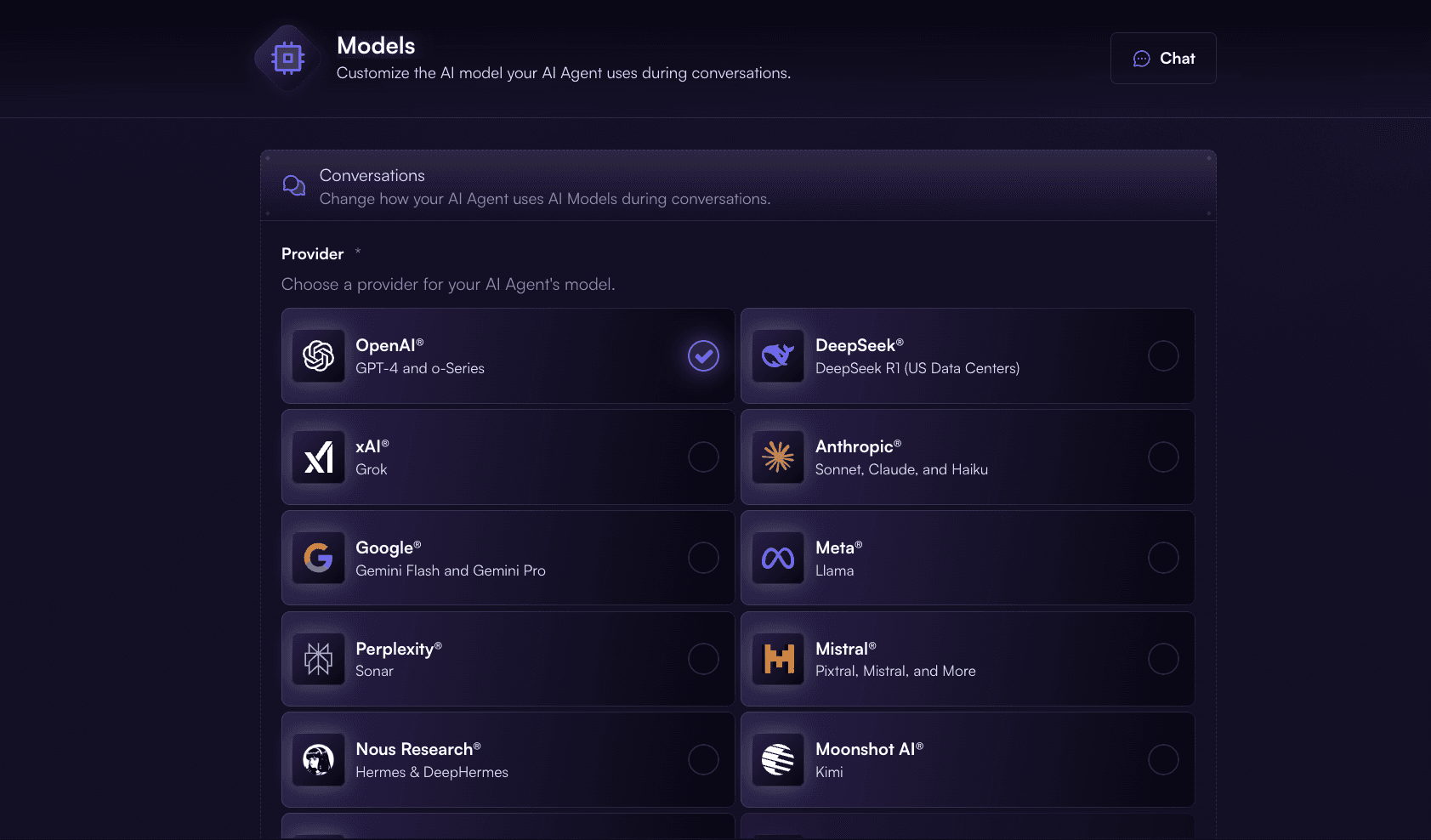
Agent.so removes that limitation by giving you access to multiple leading AI providers and their most widely used models, all in one place. This lets you choose the best AI model for each task without changing tools.
AI Provider | Best For | Common Business Use Cases | When to Choose This Provider |
|---|---|---|---|
OpenAI (GPT Models) | Writing, strategy, general business tasks | Marketing copy, blogs, emails, proposals, presentations, planning, brainstorming | When you need a flexible, all-purpose AI model that can handle many tasks well |
Anthropic (Claude Models) | PDFs, contracts, long documents, structured reasoning | Chatting with PDFs, summarizing reports, analyzing policies, decision support | When accuracy, clarity, and document understanding matter |
Google (Gemini Models) | Analysis, planning, multimodal tasks | Research, data-heavy work, planning, tasks involving text and images | When you need deeper analysis or step-by-step reasoning |
Perplexity (Sonar Models) | Real-time research and live information | Market research, trend analysis, competitive research, current events | When up-to-date information is critical |
xAI (Grok Models) | Reasoning and fast research | Analytical thinking, exploration, contextual research | When you want quick, thoughtful insights |
Cost-efficient reasoning and scale | Large-volume analysis, automation, repetitive reasoning tasks | When efficiency and scalability are priorities | |
Meta (LLaMA Models) | Flexible and open workflows | Custom use cases, experimentation, open-model exploration | When flexibility and customization are important |
Speed and creative tasks | Fast content generation, creative ideation, lightweight workflows | When responsiveness and speed matter most | |
Moonshot AI (Kimi) | Large documents and long context | Reviewing long reports, research papers, extended conversations | When working with very large inputs |
Alibaba Cloud (Qwen) | Multilingual and global workflows | Multilingual content, international communication, global research | When working across languages and regions |
GPT vs Claude vs Gemini: Which AI Model is Best for Business?
This is one of the most searched questions by entrepreneurs and startup teams. The short answer is that there is no single best AI model for business. Each excels at different tasks.
GPT for Business Work and Writing: ideal for marketing content, emails, strategy, planning, brainstorming, and general productivity.
Claude for Documents and Deep Reasoning: especially strong at working with long documents like PDFs, contracts, policies, and reports.
Gemini for Analysis and Multimodal Tasks: for when work involves deeper analysis, planning, or combining text with documents and images. They are well suited for research-heavy and analytical workflows.
Rather than choosing one forever, many businesses use GPT, Claude, and Gemini together depending on the task.
What to Consider When Choosing an AI Model
You do not need to understand the technical details behind AI models to make smart decisions for your business. What matters most is aligning the model with the type of work you are doing.
If your day-to-day tasks involve writing, marketing, planning, or general problem-solving, a versatile model designed for broad business use will usually perform best.
If you regularly work with long documents such as PDFs, contracts, or reports, you will want a model that can handle large amounts of text while maintaining clarity and accuracy. For teams that rely heavily on research or current information, choosing a model that excels at real-time or up-to-date knowledge can make a meaningful difference.
It is also worth considering whether speed or cost efficiency is more important for a given task. Some workflows benefit from fast, lightweight models that can handle high volumes of requests, while others require deeper reasoning and more thoughtful responses.
Why Agent.so is Different
Most AI platforms make you choose one model and adapt your workflow around it. Agent.so takes a more flexible approach.
With Agent.so, you can switch between different AI models on the same AI agent, depending on what you need in the moment.
Writing, research, reasoning, speed, or document analysis can all happen in the same conversation, without switching tools or managing multiple subscriptions.
The Smartest Way to Work with AI
Writing, research, document analysis, strategy, and automation all benefit from different strengths, and no single AI model excels at everything.
Agent.so is built around this reality. Instead of locking you into one provider, it brings together the most popular AI models for business and lets you switch between them within the same AI agent as your needs change. That means you can move seamlessly from drafting content to analyzing contracts to researching new markets without changing tools or workflows.
For entrepreneurs, freelancers, and startups, this flexibility translates directly into speed, efficiency, and better results. You get higher-quality outputs, less tool friction, and more leverage from a small team.

If you want a smarter way to work with AI, one that adapts to your business instead of forcing your business to adapt to a tool, Agent.so gives you everything you need in one platform.
If you are using AI to run or grow a business, you have probably noticed something confusing. There is no longer just “one AI.”
Instead, there are multiple AI models, each designed for different types of work. Some are better at writing and strategy. Others excel at deep reasoning, document analysis, real-time research, or fast responses at scale.
Choosing the right AI model can dramatically improve the quality of your output, whether you are drafting marketing copy, analyzing contracts, building software, or researching new markets.
Rather than asking which AI model is the best overall, a better question is: Which AI model is best for this specific task?
Why Different AI Models Exist
AI models are trained differently and optimized for different strengths. That is why one model might feel amazing for writing but weaker for logic, while another shines when analyzing long PDFs or reasoning through complex problems.
Here are a few common distinctions between AI models:
General-purpose AI models are great for writing, brainstorming, and day-to-day business work
Reasoning-focused AI models are better for strategy, analysis, and multi-step problem solving
Fast AI models are designed for speed and high-volume workflows
Real-time AI models specialize in live knowledge and research
Long-context AI models are ideal for working with large documents like PDFs and contracts
The challenge for most teams is that many AI platforms lock you into just one of these.
The Most Popular AI Models Are Available on Agent.so
Agent.so removes that limitation by giving you access to multiple leading AI providers and their most widely used models, all in one place. This lets you choose the best AI model for each task without changing tools.
AI Provider | Best For | Common Business Use Cases | When to Choose This Provider |
|---|---|---|---|
OpenAI (GPT Models) | Writing, strategy, general business tasks | Marketing copy, blogs, emails, proposals, presentations, planning, brainstorming | When you need a flexible, all-purpose AI model that can handle many tasks well |
Anthropic (Claude Models) | PDFs, contracts, long documents, structured reasoning | Chatting with PDFs, summarizing reports, analyzing policies, decision support | When accuracy, clarity, and document understanding matter |
Google (Gemini Models) | Analysis, planning, multimodal tasks | Research, data-heavy work, planning, tasks involving text and images | When you need deeper analysis or step-by-step reasoning |
Perplexity (Sonar Models) | Real-time research and live information | Market research, trend analysis, competitive research, current events | When up-to-date information is critical |
xAI (Grok Models) | Reasoning and fast research | Analytical thinking, exploration, contextual research | When you want quick, thoughtful insights |
Cost-efficient reasoning and scale | Large-volume analysis, automation, repetitive reasoning tasks | When efficiency and scalability are priorities | |
Meta (LLaMA Models) | Flexible and open workflows | Custom use cases, experimentation, open-model exploration | When flexibility and customization are important |
Speed and creative tasks | Fast content generation, creative ideation, lightweight workflows | When responsiveness and speed matter most | |
Moonshot AI (Kimi) | Large documents and long context | Reviewing long reports, research papers, extended conversations | When working with very large inputs |
Alibaba Cloud (Qwen) | Multilingual and global workflows | Multilingual content, international communication, global research | When working across languages and regions |
GPT vs Claude vs Gemini: Which AI Model is Best for Business?
This is one of the most searched questions by entrepreneurs and startup teams. The short answer is that there is no single best AI model for business. Each excels at different tasks.
GPT for Business Work and Writing: ideal for marketing content, emails, strategy, planning, brainstorming, and general productivity.
Claude for Documents and Deep Reasoning: especially strong at working with long documents like PDFs, contracts, policies, and reports.
Gemini for Analysis and Multimodal Tasks: for when work involves deeper analysis, planning, or combining text with documents and images. They are well suited for research-heavy and analytical workflows.
Rather than choosing one forever, many businesses use GPT, Claude, and Gemini together depending on the task.
What to Consider When Choosing an AI Model
You do not need to understand the technical details behind AI models to make smart decisions for your business. What matters most is aligning the model with the type of work you are doing.
If your day-to-day tasks involve writing, marketing, planning, or general problem-solving, a versatile model designed for broad business use will usually perform best.
If you regularly work with long documents such as PDFs, contracts, or reports, you will want a model that can handle large amounts of text while maintaining clarity and accuracy. For teams that rely heavily on research or current information, choosing a model that excels at real-time or up-to-date knowledge can make a meaningful difference.
It is also worth considering whether speed or cost efficiency is more important for a given task. Some workflows benefit from fast, lightweight models that can handle high volumes of requests, while others require deeper reasoning and more thoughtful responses.
Why Agent.so is Different
Most AI platforms make you choose one model and adapt your workflow around it. Agent.so takes a more flexible approach.
With Agent.so, you can switch between different AI models on the same AI agent, depending on what you need in the moment.
Writing, research, reasoning, speed, or document analysis can all happen in the same conversation, without switching tools or managing multiple subscriptions.
The Smartest Way to Work with AI
Writing, research, document analysis, strategy, and automation all benefit from different strengths, and no single AI model excels at everything.
Agent.so is built around this reality. Instead of locking you into one provider, it brings together the most popular AI models for business and lets you switch between them within the same AI agent as your needs change. That means you can move seamlessly from drafting content to analyzing contracts to researching new markets without changing tools or workflows.
For entrepreneurs, freelancers, and startups, this flexibility translates directly into speed, efficiency, and better results. You get higher-quality outputs, less tool friction, and more leverage from a small team.
If you want a smarter way to work with AI, one that adapts to your business instead of forcing your business to adapt to a tool, Agent.so gives you everything you need in one platform.
Guide
The Most Popular AI Models for Business, All in One Platform with Agent.so